
Every explanation of perpetual futures starts the same way. "It's a futures contract that never expires." Cool, thanks. That's like explaining a car as "a horse that doesn't eat." Technically true, completely unhelpful.
I thought I understood perps when I started trading them. You go long, you go short, there's some funding thing, and leverage makes numbers bigger. Then I tried to explain it to someone and realized I couldn't answer the most basic questions. Why does removing the expiry date matter? What's actually holding the price to reality? What happens to my position when things go wrong?
So I went back to the beginning. Read the original academic paper, the exchange docs, old blog posts from BitMEX. What I found is that a perpetual future is not just a contract — it's a whole machine. And the engineering decisions inside that machine are more interesting than anyone gives them credit for.
Why Expiry Matters More Than You Think
Let me start with what perpetual futures replaced.
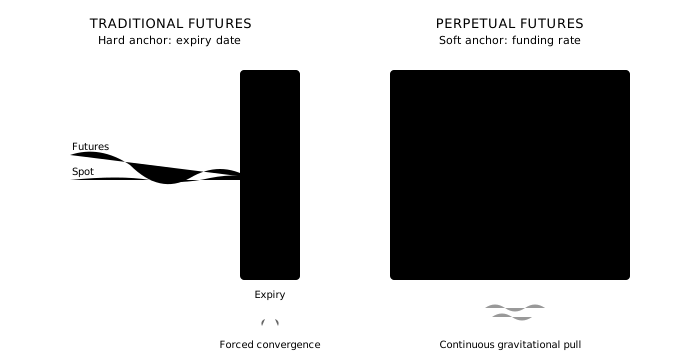
A traditional futures contract is an agreement to buy or sell an asset at a set price on a specific date. Wheat farmers have used them for over a century. The key feature: on the expiry date, the contract settles against the actual spot price. No matter how far the futures price drifts during the contract's life, expiry snaps it back.
That's important. Expiry is the anchor. It's the reason futures prices don't just float off into fantasy. Traders know that eventually, the contract will converge with reality — so they price it accordingly.
Now remove the anchor. No expiry, no forced settlement, no convergence date. The contract price could theoretically drift from spot indefinitely. Without something to replace the anchor, you don't have a useful financial instrument — you have a betting pool with no connection to the underlying asset.
This is the actual problem that perpetual futures solve. Not "how do we make a future that lasts forever" — but "how do we keep a never-ending contract honest."
Three People Built This Thing, Not One
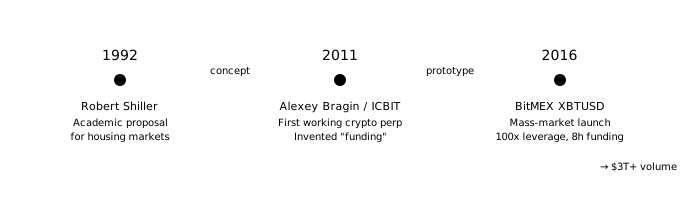
Most articles credit BitMEX with inventing perps. The real history has three acts, and I didn't know about two of them until I dug in.
Act 1: Robert Shiller, 1992. The Nobel laureate proposed perpetual futures in a 1993 Journal of Finance paper. His idea: derivatives for illiquid assets like housing and labor costs — things that don't have clean spot markets. The mechanism involved daily cash settlements mirroring an index. It never caught on. Traditional finance didn't need it.
Act 2: Alexey Bragin, 2011. This is the part nobody talks about. Bragin built a small Bitcoin exchange called ICBIT and created the first working crypto perpetual. His innovation was the "inverse" design — margined in BTC, priced in USD — which solved a real problem: another early exchange, Bitcoinica, was fragmenting its liquidity across multiple expiry contracts. Too few traders, too many contracts. Bragin consolidated everything into one. He also introduced periodic interest exchanges between traders, which he called "funding." The term stuck. (Everstrike blog)
Act 3: BitMEX XBTUSD, May 13, 2016. This is where it went mass-market. Arthur Hayes and team launched XBTUSD — no expiry, up to 100x leverage, funding every 8 hours. Traders piled in with what the BitMEX blog later called "almost fanatical enthusiasm." XBTUSD became the most traded crypto derivative of all time, with over $3 trillion in cumulative volume on BitMEX alone. Every major exchange copied the design within years. (BitMEX Blog)
What I find fascinating is the arc. An academic designed it for housing markets. A solo developer built the prototype for Bitcoin. A startup turned it into the most traded instrument in crypto. The concept found its killer app in a market Shiller never imagined — one that runs 24/7, never delivers physical goods, and desperately needed liquidity consolidation.
The Machine Inside the Contract
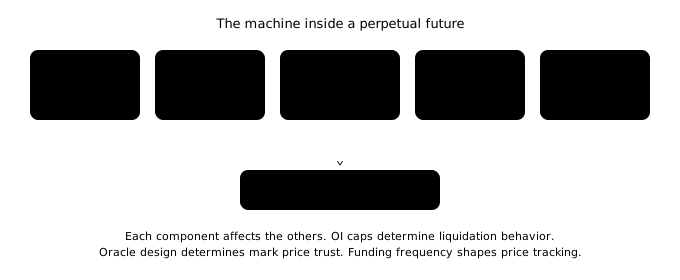
Here's where I spent the most time. A perpetual future has several moving parts, and each one matters more than you'd think.
Margin: Your Seat at the Table
To open a perp position, you put up initial margin — a deposit, usually a fraction of the position's full value. If you're trading at 10x leverage, your initial margin is about 10% of the position size.
But there's a second number: maintenance margin. This is the minimum balance you need to keep the position alive. Drop below it, and the exchange starts closing your position. The gap between initial and maintenance margin is your cushion.
Then there's a choice that tripped me up at first: cross margin vs isolated margin. Cross margin pools your entire account balance across all positions — more cushion, but one catastrophic trade can drain everything. Isolated margin fences off each position with its own collateral — losses are contained, but you manage each one separately. (MetaMask guide)
Leverage: The Math Is Unforgiving
Leverage is a multiplier on your capital. $500 at 10x leverage controls a $5,000 position. Your gains and losses are 10x what they'd be without it.
The part new traders miss: higher leverage means a smaller cushion before liquidation. At 10x, a roughly 10% adverse price move wipes you out. At 20x, it's 5%. At 40x, 2.5%. Crypto routinely has 10-20% daily moves. Do the math. (MetaMask guide)
Mark Price: The Hidden Protector
This one blew my mind a little. You'd assume your position gets liquidated based on the price you see on the trading chart. It doesn't.
Exchanges use something called the mark price, which is derived from an index of spot prices across multiple exchanges — not the last traded price on the platform you're using. Why? Because a single exchange can have a brief wick or a thin order book that sends the price spiking for a few seconds. If liquidations were based on that, traders would get wiped out by noise.
Mark price protects you from those phantom moves. It's one of those design decisions that you never notice until you understand why it's there. (MetaMask liquidation guide)
Liquidation: When the Machine Steps In
When your equity drops below the maintenance margin, the exchange forcibly closes your position. This isn't a polite suggestion. The exchange takes over and sells at market.
Behind liquidation sits a safety net with two layers:
Insurance fund — a pool of capital that absorbs losses when liquidated positions can't be filled cleanly at the expected price. Every exchange builds one from liquidation fees and excess margin.
Auto-deleveraging (ADL) — the last resort. When the insurance fund runs dry, the exchange forcibly closes the positions of the most profitable and most leveraged traders to cover the shortfall. Yes, you read that right. You can be in profit and still get your position closed because the system ran out of money. Huobi introduced ADL in 2015, and the largest event happened on October 10-11, 2025, when insurance funds were exhausted across multiple venues simultaneously. (Cube Exchange; CoinDesk)
Funding: The Anchor Replacement
This is the big one — the mechanism that solves the "no expiry, no anchor" problem.
Every few hours, one side of the trade pays the other. If the perp is trading above spot, longs pay shorts — penalizing the crowd pushing the price too high, rewarding those stepping in on the other side. Perp below spot? Shorts pay longs. The exchange takes nothing. It's a pure transfer between traders.
The effect: a continuous gravitational pull back toward spot price. Not perfect, not instant, but persistent. It replaces the hard anchor of expiry with a soft one — a financial incentive to keep the price honest.
I wrote a whole piece on how funding rates work — the formula, cross-exchange differences, the clamp function, what the numbers actually mean for your trading. If funding interests you, that's the deep dive.
Linear vs Inverse: Two Flavors
One more distinction that matters: linear (USDT-margined) contracts settle everything in stablecoins. Your margin is in USDT, your profit and loss is in USDT. Straightforward.
Inverse (coin-margined) contracts are the original BitMEX design. Margin and settlement in the underlying asset — say, BTC. The math gets weird because your collateral value moves with the price. If BTC drops and you're short (profit in USD terms), your BTC collateral is also worth less. Non-linear PnL. Most volume has migrated to linear contracts, but inverse contracts still exist on every major exchange. (Ethena docs)
Why Perps Took Over
Here's the part that surprised me most. Perps don't just exist alongside spot trading — they've swallowed it.
The numbers (as of late 2025): perpetual futures account for over 90% of global crypto derivatives volume. CEX perp volume hit $86.2 trillion in 2025, up 47.4% year-over-year. On Binance's BTC/USDT pair, 83.5% of volume is perps and just 16.5% is spot. (CCN; SQ Magazine)
Why? Five structural reasons:
- No expiry fragmentation. All liquidity concentrates in one contract per asset, instead of splitting across quarterly expiries.
- Leverage. Access larger positions with less capital.
- Short selling. Profit from falling prices without borrowing the asset.
- 24/7 trading. Matches crypto's always-on market.
- No delivery. Pure price exposure, no custody complexity.
But the most surprising finding came from academic research: futures now drive approximately 80% of permanent price movements in crypto. Information reflects in the futures market first and transmits to spot with a lag. The tail wags the dog. (Wiley)
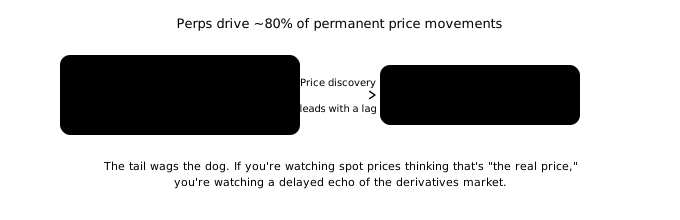
That reframed everything for me. Perps aren't just a trading tool. They've become the primary venue for price discovery. If you're watching spot prices thinking that's "the real price," you're actually watching a delayed echo of the derivatives market.
Two Architectures, One Instrument
Here's something unique about crypto perps that has no equivalent in traditional finance: they exist on two fundamentally different types of infrastructure.
Centralized exchanges (CEX) — Binance, Bybit, OKX. Deepest liquidity, fastest execution. But KYC is required, and the exchange holds your funds. Counterparty risk is real. FTX proved that.
Decentralized exchanges (DEX) — and there are two models here:
Order book DEXs like Hyperliquid and dYdX work like traditional exchanges but on-chain. Hyperliquid built its own L1 blockchain processing 200,000 orders per second. Self-custody, no KYC. I wrote a detailed walkthrough of how a perps exchange is actually built using Hyperliquid as the case study — the five engines, the JELLY incident, the whole stack.
AMM/pool-based DEXs like GMX use a liquidity pool as the counterparty. You trade against the pool, not other traders. Simpler, but liquidity providers bear directional risk.
The shift is real. DEX market share grew from 3.5% to 16.7% in a single year. Daily DEX perp volumes were approaching $10 billion as of January 2026. (Awaken Tax; Phemex)
The choice between CEX and DEX perps mirrors the central tension of crypto itself: convenience and speed (CEX) versus self-sovereignty and permissionlessness (DEX). Perps are just the highest-stakes version of that trade-off.
Perps Are Escaping Crypto
This is the part that made me sit up straight. The instrument is no longer crypto-only.
July 2025: Coinbase launched the first CFTC-regulated perpetual-style futures for US retail. Technically "long-dated futures" with a 5-year expiry and funding rates — a legal workaround to fit crypto-native mechanics into existing CFTC frameworks. Up to 10x leverage. (Coinbase blog)
February 2026: Kraken launched xStocks — the first regulated tokenized-equity perpetual futures. S&P 500, Nasdaq 100, AAPL, NVDA, TSLA, GLD. Up to 20x leverage. Available in 110+ countries, 24/7 trading. Stocks that never close. (Kraken blog)
March 2026: Hyperliquid, via Trade[XYZ], launched the first officially licensed S&P 500 perpetual on a DEX, with an actual S&P Dow Jones Indices license. You can now bet on the S&P 500 around the clock without ever touching a traditional stock exchange. This was made possible by HIP-3, Hyperliquid's permissionless market creation upgrade — which turned the exchange into a "market factory" where anyone can deploy perps on any asset. (CoinDesk)
March 2026: CFTC chair Selig is signaling further path-clearing for US perpetual futures. (CoinDesk)
Think about that arc. Shiller designed the instrument for housing in 1992. Crypto adopted it because it had the exact conditions Shiller needed — 24/7 markets, no physical delivery, fragmented liquidity. And now the instrument is circling back to traditional assets. Stocks, indices, commodities — all getting the perpetual treatment.
TD Securities put it bluntly: "Historically, margin exposure has been a catalyst in nearly every major market dislocation." If tokenized stock perps become the preferred retail vehicle, the systemic implications are serious. (TD Securities)
This is still early. The US regulatory path is evolving — CFTC statements are directional, not final rules. But the trajectory is clear.
Before Your First Trade
I'd feel wrong writing all of this without being direct about the risks.
Over $154 billion in positions were liquidated across crypto perps in 2025 alone (as of year-end 2025). (Phemex) That's not a footnote. That's the most important number in this article.
A few things I wish someone had spelled out for me:
Leverage is not free money. 10x feels exciting until you realize crypto regularly moves 10% in a day. That's a full wipeout at 10x. The exchanges offering 100x leverage aren't doing you a favor — they're offering you a faster way to lose.
Funding costs compound. Holding a leveraged position isn't free. In trending markets, funding can run above 0.1% per 8 hours — that's over 100% annualized. It's an invisible cost that new traders ignore until it's eaten their margin. Some traders try to harvest these payments through the cash-and-carry trade — but the exit is harder than the entry.
Mark price will confuse you. You'll watch the price on the chart and not understand why you got liquidated. Remember: liquidation is based on the index-derived mark price, not the last traded price on your screen.
Cross margin can nuke your account. One bad trade with cross margin can drain your entire balance. Start with isolated margin until you know exactly what you're doing.
Platform risk is real on both sides. CEX: the exchange could go insolvent (FTX). DEX: smart contracts can have bugs, oracles can be manipulated, chains can congest during the exact moments you need them most.
What I Came Away With
I started this because I realized I was trading an instrument I couldn't properly explain. What I found is that a perpetual future is a genuinely clever piece of financial engineering — a set of interlocking mechanisms (margin, mark price, funding, liquidation, insurance funds) that work together to create something that shouldn't work but does.
The origin story is better than the crypto industry gives it credit for. An academic economist, a solo developer, and a startup each contributed a piece. The instrument found its market not in housing or labor statistics, but in crypto — where 24/7 trading, no physical delivery, and desperate need for liquidity consolidation made it a natural fit.
And now it's outgrowing crypto. Stocks, indices, commodities — all getting the perp treatment. Whether that's a good thing or a systemic risk in the making, I genuinely don't know. Probably both.
If you want to go deeper on the mechanism that holds the whole thing together — funding rates — I wrote a detailed piece on how funding actually works. It picks up right where this one leaves off. And if you want to see what gets built on top of the perp infrastructure — Ethena turned the delta-neutral trade into a stablecoin, Pendle tokenizes yield into fixed vs floating, and Boros makes funding rates themselves tradeable.
That's what I know. Hoping it saves you a few rabbit holes.