
In my funding rate piece, I wrote a line about Ethena that stuck with me: "Funding rate securitization, essentially." A protocol that takes the variable funding payments from perp markets and packages them into something that looks like a stablecoin yield. Neat idea.
But I kept thinking — what if you could go further? Not just securitize one yield stream, but take any yield-bearing asset and split it open. Separate the principal from the yield. Trade each piece independently. Let someone who wants certainty lock in a fixed rate, while someone else who has a view on where yields are heading takes the other side.
Turns out, that's exactly what Pendle V2 does. And once I understood the mechanics, it reframed how I think about every yield source I've written about — staking rewards, lending APYs, funding rate payments. They're all floating. Every single one. Pendle is the infrastructure that introduced a choice.
The Problem I Didn't Realize Existed
Here's what took me a while to see.
In traditional finance, fixed income is a massive market. You buy a bond, you know your coupon rate, you hold to maturity, you get your money back plus interest. The U.S. Treasury market alone is $27 trillion. The global interest rate derivatives market is over $400 trillion in notional value. Fixed rates are the foundation that everything else is built on.
Crypto has nothing like this. Every yield source is floating.
Staking ETH on Lido? The yield fluctuates with network activity and validator tips. Lending USDC on Aave? The rate moves with supply and demand every block. Running a cash-and-carry trade? You're collecting variable funding rate payments that can flip negative overnight. Even Ethena's sUSDe — the "yield stablecoin" — is just a wrapper around those same variable funding flows.
Every yield I've covered in this series is floating. You take what the market gives you. No choice.
I didn't know how much that mattered until I read the Pendle docs and realized: the ability to convert floating yield into fixed yield isn't just a nice feature. It's the infrastructure primitive that was missing.
Bond Stripping, But Make It DeFi
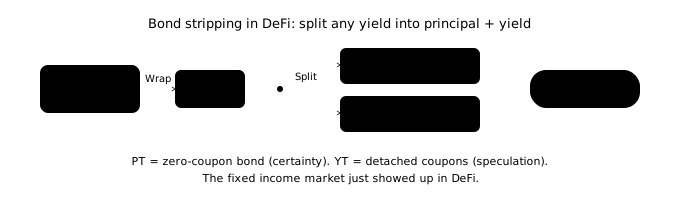
The core idea blew my mind a little when it clicked.
In TradFi, there's a concept called bond stripping. You take a bond — say, a 10-year Treasury — and separate it into two pieces. The zero-coupon bond (the principal, returned at maturity) and the detached coupons (the interest payments over time). Each trades independently. Different investors want different things: some want the certainty of getting their principal back at a known price, others want exposure to the yield stream.
Pendle does this to any yield-bearing crypto asset. The process has three steps.
Step 1: Wrap. Take a yield-bearing token — stETH, sUSDe, aUSDC, whatever — and wrap it into Pendle's Standardized Yield format (SY). This is the V2 innovation that makes the protocol permissionless: SY provides a unified interface regardless of whether the underlying is a rebasing token, an interest-bearing token, or a vault strategy. One standard, any yield source.
Step 2: Split. The SY gets minted into two tokens in a 1:1 ratio:
-
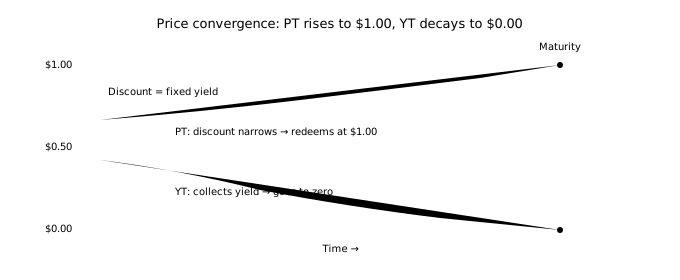
PT (Principal Token) — your claim on the underlying asset at maturity. It trades at a discount before maturity and redeems 1:1 when the term expires. That discount is the fixed yield. Buy PT-sUSDe at 0.92 with six months to maturity, and you've locked in roughly 16% annualized — no matter what happens to sUSDe yields afterward.
-
YT (Yield Token) — your right to receive all the yield the underlying generates until maturity. Then it goes to zero. Buying YT is like going long on yield with built-in leverage, because YT costs a fraction of the underlying's full value but captures the entire yield stream.
Step 3: Trade. PT and YT trade independently on Pendle's AMM. The invariant always holds: SY value = PT value + YT value. If you believe yields will stay high, buy YT. If you want certainty, buy PT. If you want to provide liquidity, supply to the pool and earn from both sides.
The analogy that made it snap for me: PT is the zero-coupon bond. YT is the detached coupon stream. The fixed income market just showed up in DeFi.
Source: Pendle V2 Docs, MixBytes Technical Analysis
The AMM That Understands Time
This is the part where I kept digging and found something genuinely clever.
Normal AMMs — Uniswap, Curve — are designed for spot trading. Their price curves don't care about time. But yield tokens are time-decaying assets. A PT that trades at 0.95 today needs to converge to 1.00 at maturity. A YT that's worth something today needs to reach zero at maturity. If you just threw PT/YT into a Uniswap pool, liquidity providers would get wrecked by the natural price convergence — it would look like massive impermanent loss, except it's actually just the math of time decay.
Pendle's AMM, adapted from Notional Finance's logarithmic curve for fixed-rate trading, accounts for this. The core formula:
Exchange Rate = (1/scalar) * ln(proportion / (1 - proportion)) + anchor
The critical thing the formula does: as maturity approaches, the curve automatically pushes PT price toward the underlying. At maturity, PT equals the underlying — no impermanent loss from the convergence, because the AMM expected it. The scalar parameter tightens the tradeable yield range over time, making the market increasingly capital-efficient as the remaining uncertainty shrinks.
What this means in practice: yields fluctuate in predictable ranges (staked ETH swings between roughly 0.5% and 12%). The AMM concentrates all liquidity within that range, rather than spreading it across the entire price spectrum. The result is up to 200x capital efficiency improvement over Pendle V1, according to the whitepaper.
One detail I found especially elegant: there's only one liquidity pool per market (PT/SY), but it serves both PT and YT trades. YT trades route through flash swaps — when you buy YT, the contract borrows SY from the pool, mints PT+YT, sends you the YT, and sells the PT back to repay the loan. All atomic. LPs earn fees from both sides of the market with a single deposit.
Source: Pendle V2 AMM Whitepaper, Pendle V2 Foundation (Medium)
Three Eras of a Protocol
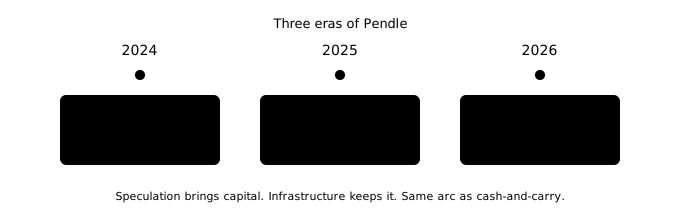
Pendle's TVL chart tells a story in three acts, and the arc is remarkably familiar.
Act 1: The Points Gold Rush (2024). EigenLayer's restaking program created a meta where airdrop "points" had implicit value. Users bought YT for leveraged exposure to these points — you're not staking more, you're buying the yield stream from someone else's stake, and that yield includes the points. TVL exploded from $300 million (as of early 2024) to $6.2 billion at its peak (as of May-June 2024, The Defiant). PENDLE token surged 5x. Then the EigenLayer airdrop happened. The points meta died. TVL crashed 70% to $2 billion within months. PENDLE dropped 40% in a single week.
The growth was mercenary — capital came for the airdrop incentives and left when they ended. Anyone who's watched crowded trades unravel will recognize the pattern.
Act 2: The Stablecoin Pivot (2025). Ethena's sUSDe integration changed the composition entirely. Stablecoins went from under 20% to 83% of Pendle's TVL. Ethena-linked assets — USDe, sUSDe — represented roughly 70% of all deposited funds (as of late 2025, WEEX Report). TVL recovered to $13.1 billion at its peak. Annual trading volume hit $47.8 billion. Revenue reached $40 million annualized (as of 2025, Investing.com).
Over 45% of PT tokens were being used as money market collateral on Aave — meaning Pendle wasn't just a trading venue anymore. It was minting a DeFi-native fixed income instrument that other protocols treated as collateral. That's infrastructure.
Act 3: The Yield Stack (2026). Boros launched to tokenize off-chain funding rates. sPENDLE replaced the old vePENDLE staking model with liquid staking. Expansion plans include Solana, Hyperliquid, and TON. The protocol is reaching beyond on-chain yields toward the entire funding rate ecosystem.
What struck me: this is the exact same arc I documented in the cash-and-carry piece. Simple strategy attracts massive capital. Yields compress as the trade gets crowded. What survives is more sophisticated infrastructure. Pendle went from "airdrop farming tool" to "DeFi fixed income layer" in the same way cash-and-carry went from "free money" to "requires operational sophistication."
The Loop That Ate DeFi
The biggest thing I found in the research wasn't a feature. It was a strategy — one that has become the dominant yield play in DeFi and the biggest systemic risk I've come across.
The Pendle-Aave-Ethena loop works like this:
- Deposit sUSDe into Pendle → receive PT-sUSDe (locking in fixed yield of roughly 8-13%)
- Deposit PT-sUSDe as collateral on Aave (Max LTV: 88.9% in E-Mode)
- Borrow USDe from Aave at roughly 4-6% variable rate
- Convert borrowed USDe to sUSDe
- Repeat
The spread — PT fixed yield minus borrowing cost — gets amplified by leverage. With 88.9% LTV, that's theoretical leverage up to 9x. The scale is staggering: $4.2 billion of PT tokens sitting as Aave collateral, and an Ethena-related Aave footprint of $6.6-6.8 billion (as of early 2026, The Block). Pendle holds roughly 60% of total sUSDe supply.
Chaos Labs formally debated the risks of this loop in Aave governance. Here's what they flagged, and what I think matters most:
Liquidation cascades. If PT discount widens — meaning the market suddenly demands a higher yield to hold these tokens — collateral values drop and Aave liquidations fire. (The liquidation waterfall mechanics I documented for perps exchanges apply to Ethena's short positions too — and stress in that layer cascades up through PT.) But liquidating PT means selling it, which widens the discount further, which triggers more liquidations. A classic reflexive spiral.
The self-limiting dynamic amplified. This is the same pattern from the cash-and-carry piece, but with extra leverage layers. More looping → more USDe demand → Ethena has to open more perp shorts → funding rates compress → sUSDe yield drops → PT yield drops → the loop becomes unprofitable → unwind. The strategy's success is its own structural drag — and the leverage makes both the upside and the downside bigger.
I want to be clear about what "fixed yield" actually means here, because this tripped me up. PT guarantees 1:1 redemption in the underlying asset, not in dollars. If USDe depegs — and it hit $0.65 on Binance in October 2025 — PT holders eat the full loss. You have "fixed" exposure to something that itself can move. The fixed rate is real. The dollar stability is not guaranteed.
Source: The Block, ChainCatcher
Boros: When the Funding Rate Itself Becomes Tradeable
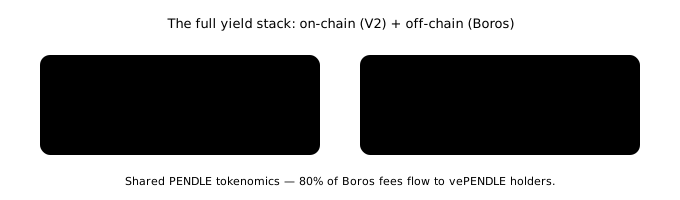
This is where the whole series connects.
In the funding rate article, I covered how funding works — the formula, the clamp function, the floor-ceiling-skew framework. In the cash-and-carry piece, I covered how you harvest funding — and why the biggest risk is funding reversal. Three weeks of steady income wiped by a sentiment shift.
Boros, launched by Pendle in August 2025 on Arbitrum, takes the funding rate itself and turns it into a tokenized yield that you can split, trade, and hedge. I wrote a full piece on how Boros works — the yield unit instrument, the three use cases, and why this is "a derivative of a derivative."
The instrument is called a Yield Unit (YU). Each YU represents the funding rate income from one unit of collateral on a specific exchange. Long YU means you pay a fixed rate and receive whatever the floating funding rate turns out to be. Short YU means you receive fixed and pay floating.
If you're running a cash-and-carry trade and want to eliminate the funding reversal risk — the single biggest vulnerability in the strategy — you short the YU. Lock in a fixed funding income. The variable part gets transferred to whoever took the other side.
Historical performance: BTC fixed APR on Boros averaged 6-11.4%, with peaks at 23.5% during volatile periods (as of October-November 2025, Boros Medium). Open interest reached $6.9 billion by January 2026 (as of January 2026, Boros Docs).
What I find most interesting is the cross-exchange arbitrage it enables. When Hyperliquid's funding rate is 9.6% and Binance's is 6%, you can structure a four-leg trade through Boros that captures the spread as delta-neutral, funding-neutral, fixed yield. No directional exposure, no funding reversal risk. Just the spread.
Pendle V2 tokenizes on-chain yields — staking, lending, delta-neutral carry. Boros tokenizes off-chain yields — perp funding rates across CEXs and DEXs. Together, they cover the full spectrum:
| On-chain yields (V2) | Off-chain yields (Boros) |
|---|---|
| Staking (stETH) | Funding rates (BTC, ETH perps) |
| Lending (aUSDC) | Cross-exchange basis |
| Delta-neutral carry (sUSDe) | Perpetual premium |
The global interest rate swap market in TradFi is $469 trillion in notional. Boros is the crypto-native version, at microscopic scale. But the architecture is there.
Source: Blockworks, CoinDesk
The Risks I'd Want to Know About
I've tried to flag risks throughout the piece, but let me collect the ones I think matter most.
Concentration in one yield source. Roughly 70% of Pendle TVL is Ethena-linked. Pendle holds about 60% of all sUSDe in existence. If Ethena faces structural issues — deeper funding rate compression, a depeg event, regulatory action — Pendle takes the hit proportionally. This isn't a diversified fixed income market. It's heavily weighted toward one underlying.
Maturity walls. When large pools mature simultaneously, TVL can drop dramatically. In June 2024, TVL fell 45% in a single week as major markets expired (The Defiant). Users have to actively roll their positions into new maturity pools — there's no auto-rollover yet (though it's on the 2026 roadmap). If users don't roll, liquidity fragments.
YT is a wasting asset. YT goes to zero at maturity. Under constant implied yield, the decay is roughly linear. New users might not realize they're buying something that loses value every day by design. The risk profile is similar to buying options — time is always working against you. If realized yield disappoints relative to the implied APY you paid, total loss is possible.
Smart contract composability. Pendle interacts with Lido, Ethena, Aave, and dozens of other protocols. Each integration adds an attack surface. The protocol has been audited by Ackee, Dedaub, Dingbats, and Code4rena — but composability risk compounds across the stack. A bug in any one integration can cascade.
Regulatory ambiguity. No regulatory body has explicitly addressed DeFi yield tokenization. PT and YT could plausibly be classified as securities. The Pendle-Aave-Ethena loop effectively creates leveraged structured products — the kind of thing that tends to attract regulatory attention once it reaches sufficient scale.
Source: Coin Bureau, CoinGecko
What I Came Away With
I started this because Pendle kept showing up in my research on funding rates, cash-and-carry, and Ethena — always in the background, always doing something load-bearing. What I found is that Pendle V2 isn't just another DeFi protocol. It's the infrastructure layer that introduced choice to an ecosystem that only had floating rates.
The mechanism is TradFi-clean. Bond stripping — separating principal from yield — is a concept that's been powering fixed income markets for decades. Pendle operationalized it on-chain with a permissionless wrapper standard (SY) and a time-aware AMM that eliminates the impermanent loss problem that would normally make yield token markets unworkable.
The growth arc is a pattern I keep seeing. Speculation brings the capital. Infrastructure keeps it. Pendle's pivot from airdrop farming to stablecoin fixed income mirrors what happened with cash-and-carry — the simple version gets crowded, yields compress, and what survives is the more sophisticated infrastructure.
The Pendle-Aave-Ethena loop is the thing to watch. It's the dominant yield strategy in DeFi, and it's also a tightly coupled system where stress in any one protocol propagates to the others. The leverage amplifies both directions. This is probably the most important systemic risk in DeFi right now that doesn't get enough attention outside of governance forums.
Boros closes the loop with everything I've written. The funding rate article explains how funding works. The cash-and-carry article shows how you harvest it. Pendle V2 lets you tokenize any yield. Boros extends that to funding rates themselves. The yield stack is becoming composable — and that's both powerful and fragile.
Every yield source I've covered in this series is floating. Staking rewards, lending rates, funding payments — they all move with market sentiment. Pendle is the first protocol that lets you choose: take the float, or lock in the fixed. That's a small idea with enormous implications.
That's what I know. Hoping it saves you a few rabbit holes.