
I mentioned the cash-and-carry trade in my funding rate piece — buy spot, short the perp, collect positive funding. Delta-neutral. The "risk-free" yield everyone talks about.
I kept digging. Read the BIS working paper. Went through October 2025 post-mortems. Looked at what happened to Ethena's USDe during the crash. Pulled apart the CME basis trade unwind. And what I found changed how I think about the whole strategy.
The carry is easy. Genuinely easy. You can set it up in ten minutes on most exchanges. But the "carry out" — unwinding the trade when conditions shift — is where the strategy actually lives or dies. And almost nobody talks about it.
The Setup (The Easy Part)
Let me get the mechanics out of the way quickly, since I covered the foundations in my pieces on perpetual futures and funding rates.

The trade has two legs:
- Buy spot — hold the actual asset (or an ETF, or a spot position on exchange)
- Short the perpetual — equal notional value, same asset
Price goes up? Your spot gains, your short loses. Price goes down? Your short gains, your spot loses. Net directional exposure: zero. Your profit comes entirely from one source: funding rate payments flowing from longs to shorts.
When funding is positive — which it is the majority of the time, because crypto structurally has more demand for leveraged longs than shorts — you collect a payment every 8 hours (on most CEXs) or every hour (on Hyperliquid).
The math looks great on paper. A funding rate of 0.01% per 8-hour period compounds to about 10.95% annualized. During the 2021 bull run, rates were routinely 0.05-0.10% per period — that's 55-110% annualized. Free money, right?
Here's the thing: the entry is mechanical. Any guide can walk you through it. The real questions are the ones that come after. When do you get out? How do you get out? What happens when you can't?
The Carry Out Problem

This is the part that made me rethink everything.
To close a cash-and-carry trade, you need to unwind both legs simultaneously. Sell your spot. Close your short. At the same time. Any gap between the two creates temporary directional exposure — and that exposure can eat your accumulated profits in seconds.
Think about what that actually requires. You're making two separate trades, possibly on two different order books, in a market that might be moving fast. If you close the short first and price drops before you sell the spot, you lose on the spot leg. If you sell spot first and price spikes before you close the short, you lose on the perp leg.
In calm markets, this is manageable. A few seconds of delay, a few basis points of slippage. Not great, not catastrophic.
In volatile markets — which is exactly when you're most likely to want out — it's a different story entirely.
When the exits jammed
October 10, 2025 was the most severe stress test delta-neutral strategies have ever faced in crypto. The numbers from the Amberdata post-mortem still startle me:
- $19.13 billion liquidated in 24 hours
- $6.93 billion in 40 minutes
- $3.21 billion in a single minute
- BTC dropped 14% in hours. Solana fell 40%. Toncoin dropped 80% intraday.
For cash-and-carry traders, the failures stacked up in layers. Order book depth shrank by 90% on key venues — the liquidity you needed to exit simply wasn't there. Spreads widened from single-digit basis points to double-digit percentages. And it got worse.
Exchanges triggered auto-deleveraging (ADL), which I covered in my exchange architecture piece. ADL forcibly closes profitable positions when insurance funds run dry. FTI Consulting's analysis describes what this means for a cash-and-carry trader: "ADL can involuntarily close profitable shorts, turning a hedged portfolio into a naked one during periods of stress."
Read that again. Your profitable short — the hedge that makes your position delta-neutral — gets forcibly closed. Now you're sitting on naked spot in the middle of a crash. That's not a risk most people factor in when they set up the trade.
And then the infrastructure failed. Binance's API froze. Withdrawals stalled. Funding rates diverged by 2.51 percentage points across venues. If you had legs on different exchanges, you couldn't close them even if you wanted to.
The timing trap
Even without a crash, timing the exit is harder than it sounds. The signal to exit is usually falling funding rates — when the payments you're collecting shrink toward zero or go negative. But funding can flip without warning. Three weeks of steady +0.03% per period (roughly 9% cumulative) can get wiped by a sharp sentiment shift.
The cruel irony: the moment funding reverses is often the same moment markets turn volatile, which is exactly when clean exits are hardest. Your exit signal and your exit difficulty spike together.
Professional desks handle this with multi-leg execution algorithms — platforms like Talos and Paradigm that close both positions atomically. Binance's built-in arbitrage bot uses spread control mechanisms (-0.1% max entry spread, 0.1% max exit spread). Individual traders don't have this infrastructure, which makes the carry-out problem fundamentally harder at retail scale.
Leverage: The Silent Killer of "Risk-Free" Carry
This was the data point that rewired my thinking about position sizing.
The BIS Working Paper 1087 found that at just 10x leverage — far below the maximum offered on most exchanges — cash-and-carry strategies would have faced liquidation in over 50% of the months in their sample. A CEPR analysis showed that a standardized 10% increase in carry predicts 22% higher sell liquidations relative to open interest.
The relationship between leverage and returns is non-linear in a way that punishes overconfidence. An academic study across CEX and DEX venues found:
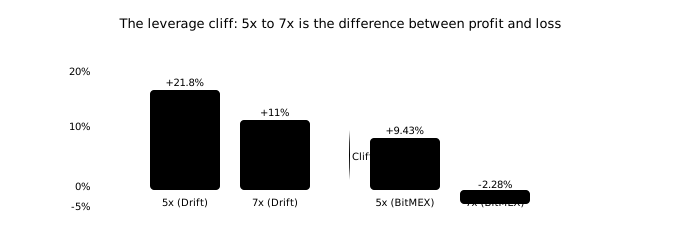
- On Drift: 5x leverage yielded 21.8% return. 7x yielded 11%.
- On BitMEX: 5x yielded 9.43% profit. 7x yielded -2.28% loss.
The difference between 5x and 7x is the difference between profit and loss. Not a gradual decline. A cliff.
Why? Because leverage doesn't just amplify returns — it narrows your margin of survival. A sharp rally squeezes the short leg's margin. Even though your spot position profits equally, the margin call comes before the hedge can save you. The trade is delta-neutral in theory. The margin account doesn't know that.
The safest configuration: 1x leverage, fully collateralized. Your short position is backed by enough capital that liquidation is essentially impossible. The cost is capital efficiency — you need double the capital. But you also can't get blown out.
Professional allocation typically runs a 70/30 split: 70% to spot, 30% to perpetual margin, with the remainder as buffer. This isn't theoretical — it's what desks actually deploy after learning the hard way.
The Trillion-Dollar Natural Experiment
Here's where the cash-and-carry story gets institutional — and where the strategy's limits became clearest.
When spot Bitcoin ETFs launched in January 2024, they created something new: the first truly scalable institutional basis trade. Buy IBIT (or FBTC, or any spot ETF). Short CME Bitcoin futures. Lock in the basis at entry. Wait for convergence at quarterly expiry.
The results were dramatic. According to Substack analysis, an estimated 20-35% of the $114 billion in Bitcoin ETFs represented basis trade capital — not conviction holders, not long-term allocators. Arbitrage money.
And for a while, the yields were stunning. Roughly 25% annualized in February 2024. Over 20% in November 2024 during the election rally. Hedge funds piled in. CFTC data from January 2026 showed leveraged funds held 15,399 short CME contracts versus only 3,003 longs — a 5:1 short-to-long ratio. The basis trade was the trade.
Then the carry compressed.
By February 2026, CME basis had fallen to approximately 4% annualized — the lowest in nearly two years, and critically, below Treasury yields (as of February 2026, CryptoQuant analysis). When you can earn more from T-bills than from a leveraged crypto arb trade that requires double the capital (CME doesn't allow cross-margining — you can't post spot Bitcoin as futures collateral), the math simply stops working.
The unwind was mechanical. CME open interest fell from 175,000 BTC to roughly 123,000 BTC. CoinDesk reported $4 billion in ETF outflows between October-November 2025, reflecting basis trade unwind, not capitulation. The correlation between basis compression and ETF outflows was 0.878 — almost perfectly mechanical.
This is the carry-out problem at institutional scale. When everyone is in the same trade and yields drop below their hurdle rate, they all leave through the same door. The "institutional floor" under Bitcoin turned out to be conditional on the trade remaining profitable.
The Ethena Experiment: Cash-and-Carry as a Stablecoin
I mentioned Ethena briefly in my funding rate article. After digging deeper into the research, I think Ethena is the purest demonstration of both the power and the limits of cash-and-carry.
Ethena's USDe is, at its core, a securitized cash-and-carry trade. Long spot crypto, short perps on Binance, Bybit, and OKX. The yield comes from funding payments. At peak, the protocol held $14 billion in market cap — the largest single cash-and-carry operation in crypto.
The numbers from Ethena's own risk docs are instructive. Negative funding occurred on only 17.5% of ETH days and 15.9% of BTC days. The longest negative streak was 13 days. The longest positive streak: 176 days. A $41.8 million reserve fund backstops negative periods.
But here's what I found most revealing: the self-limiting dynamics. More USDe demand means more shorting, which means lower funding rates, which means lower yields. The protocol's own growth compressed the yields it depended on. Average funding rates dropped from approximately 11% annualized in 2024 to approximately 5% in 2025 (Coin Metrics data).
And then October 2025 hit. USDe traded at $0.65 on Binance — a 35% discount from its $1 peg. The "stablecoin" backed by delta-neutral positions proved to be stable only when the delta-neutral trade itself was stable.
The structural shift since then tells the story: perpetual futures now represent only 11% of USDe's backing, down from 93% at the start of 2025. The remaining 89% has shifted to liquid stablecoins and lending. Even the largest operator has retreated from pure carry.
What Realistic Returns Actually Look Like
Let me be honest about the numbers, because the gap between theoretical and actual returns is where most of the disappointment lives.
Theoretical: 0.01% per 8-hour period = 10.95% annualized. 0.03% = 32.85%.
What professional desks actually earn over extended periods: 8-15% annualized. After fees, slippage, borrowing costs, and the occasional funding reversal.
CME basis trade (as of February 2026): approximately 4% annualized, before ETF management fees of 20-50 basis points per year. Below Treasuries.
Fee breakeven: On Hyperliquid, with roughly 0.14% in round-trip fees, it takes about 2 days at 0.01% per 8-hour funding just to cover your entry and exit costs. If funding drops before you hit breakeven, you've paid to lose money. (Hyperliquid's HIP-3 markets have even lower fees in Growth Mode — 0.0045% taker — which meaningfully changes the breakeven math for carry trades on those assets.)
Hidden costs: Stablecoin borrowing rates can spike above 20% annualized during bull markets. If you're borrowing USDT to fund the trade, that cost can exceed your funding income.
An academic study did find returns as high as 115.9% over six months on a diversified portfolio — but that includes extreme outlier periods with historically elevated funding. Extrapolating from those conditions is how people get hurt.
The honest benchmark for a well-executed cash-and-carry in current conditions: single-digit to low-teens annualized, before costs. Not the 30-50% theoretical numbers. Not "risk-free." Not "passive income."
The Strategy Is Evolving, Not Dying
The pure cash-and-carry may be compressing, but the underlying logic — harvesting the structural premium that shorts receive in crypto — hasn't disappeared. What's changing is how traders access it.
Fixing the rate dimension. Boros — Pendle's interest rate swap platform — lets you short yield units to lock in a fixed funding income on your carry trade. It solves the slow-bleed scenario where funding gradually compresses over weeks. It doesn't solve the acute crisis scenario (October 2025-style liquidation cascades). But for the rate dimension alone, the carry-out problem now has a hedge.
Tokenizing the yield. Pendle V2 takes it further — splitting any yield-bearing token into principal and yield components. The Pendle-Aave-Ethena loop that locks sUSDe into fixed-rate PT tokens and borrows against them has become the dominant yield strategy in DeFi. It's also the biggest systemic risk I've come across, with $4.2B of PT tokens as Aave collateral.
Sentiment-gated entry. CF Benchmarks research backtested a strategy that only enters carry during "extreme greed" (Fear & Greed index above 0.8) and exits during fear. The result: a 1.52 Sharpe ratio versus 1.51 for always-on carry. Similar total returns, but concentrated in higher-quality periods and avoiding the low-funding regimes that bleed you with costs and risks.
Dynamic allocation. Ethena's pivot is instructive. When funding is high, deploy to perp shorts. When it compresses, park in Treasuries or stablecoin lending. Not pure arb anymore — more like a yield rotation strategy that uses carry as one instrument among several.
Exchange-native bots. Binance, OKX, and Bybit all offer built-in funding rate arbitrage bots that handle both legs with spread control. These don't solve the structural risks, but they address the execution complexity that makes manual carry-out dangerous. For smaller accounts, this is probably the most practical access point.
Structured products. STS Digital partnered with Kraken on Dual Investment products. Coinbase launched a Bitcoin Yield Fund. BlackRock filed for a staked-ether ETF. The second wave of institutional crypto investors, according to Coinbase's March 2026 research, is prioritizing income over appreciation. The demand for yield isn't going away — it's being packaged differently.
Basis overlay. Instead of pure arbitrage, some traders use the basis trade as yield enhancement on crypto they already hold. You were going to hold the BTC anyway. Adding a short perp overlay during high-funding periods extracts yield from a position you'd have regardless. More like covered call writing than pure arb.
The trajectory follows the same path as every other financial strategy that gets crowded: the simple version gets competed away. What replaces it is more nuanced, more conditional, and rewards operational sophistication.
What I'd Tell Someone Considering This Trade
I'm not going to pretend I've mastered cash-and-carry. I've spent weeks in the research and what I came away with is more respect for the complexity, not more confidence in easy returns. But here's what I'd want to know if I were starting from scratch.
The carry is not the strategy. The carry out is the strategy. Plan your exit before you enter. What funding rate triggers your exit? How will you close both legs? What's your plan if one exchange goes down mid-unwind?
1x leverage or don't bother. The BIS data on liquidation at 10x leverage is the strongest argument I found in all the research. The capital efficiency loss hurts. Getting liquidated on a "delta-neutral" trade hurts more.
Same exchange when possible. Cross-exchange execution introduces risks — infrastructure failure, withdrawal freezes, settlement timing — that don't show up in backtests. If you must go cross-exchange, keep extra margin on both sides and accept that you're adding a category of risk.
8-15% annualized is the realistic professional benchmark. If someone is promising you 30%+ from cash-and-carry in current conditions (as of March 2026), they're either using leverage that will eventually blow up, cherry-picking a high-funding window, or selling you something.
Watch the reflexivity. More capital entering carry trades compresses the yields those trades depend on. This is the same dynamic that compressed active management alpha in equities when ETFs scaled up. The strategy works until it's too popular, then it works less, then everyone leaves, and then — maybe — it works again.
What I Came Away With
I started this because the cash-and-carry trade seemed like the most straightforward strategy in crypto. Buy spot, short perp, collect funding. What I found is that the entry is the least interesting part. The real strategy is everything that comes after: monitoring funding, managing leverage, planning the exit, surviving the moments when the infrastructure fails.
October 2025 showed what happens when delta-neutral doesn't mean safe. The ETF basis trade showed what happens when a trillion dollars tries to exit the same carry trade. Ethena showed what happens when the strategy's own success is its biggest structural risk.
The cash-and-carry isn't dead. But the version where you set it and forget it — the "risk-free yield" that crypto Twitter sells — that version is dead. What's left is a real strategy that demands real execution, conservative sizing, and honest expectations about returns.
That's what I know. Hoping it saves you a few rabbit holes.