
The most-traded asset on DeFi's fastest-growing derivatives exchange is not Bitcoin. It's not Ethereum. It's not a meme coin or a governance token.
It's crude oil.
WTI crude perpetuals on Hyperliquid hit $1.27 billion in daily volume in March 2026. Brent crude: $1.04 billion. Silver: $1.01 billion. Commodities now make up over 67% of volume on Hyperliquid's newest markets. (CryptoTimes; AInvest)
Six months ago, you couldn't trade oil on Hyperliquid. The exchange listed crypto perps and nothing else. The team decided what markets to add, like every other exchange. Then HIP-3 happened.
I'd been following Hyperliquid since writing about how perps exchanges are built -- the five engines, the JELLY incident, the architecture that puts an order book inside blockchain consensus. When I first saw HIP-3 mentioned, I assumed it was some kind of liquidity upgrade. A protocol-level market maker, maybe. I was wrong. It's something more fundamental than that, and it took me a while to understand why it matters.
What I Got Wrong (And What HIP-3 Actually Is)

Let me correct myself up front. When I started researching, I confused HIP-3 with Hyperliquid's market-making infrastructure. That role belongs to HLP (Hyperliquidity Provider) and HIP-2 -- the protocol's existing systems for providing liquidity to order books. I covered HLP in the exchange architecture piece as Engine 4's backstop vault.
HIP-3 is not about liquidity. It's about who gets to create markets.
The full name is "Builder-Deployed Perpetuals," and it launched on October 13, 2025. The mechanism: anyone who stakes 500,000 HYPE tokens (roughly $19-40 million depending on HYPE's price) can deploy their own perpetual futures markets on Hyperliquid's matching engine. The deployer controls everything -- which asset to track, which oracle to use, what leverage to allow, how fees are structured. Hyperliquid provides the infrastructure: the order book, the consensus, the settlement layer. The deployer provides the market. (Hyperliquid Docs)
Before HIP-3, Hyperliquid worked like every other exchange. The team picked which perps to list. After HIP-3, anyone with enough capital can list anything -- crypto, stocks, commodities, indices, bonds, even Pokemon cards. The shift isn't technical. The matching engine already existed. What changed is structural: market creation got decoupled from market operation.
The analogy that kept coming back to me: Hyperliquid went from being a restaurant to being a commercial kitchen that anyone can cook in. Same ovens, same equipment -- including the funding rate mechanism that anchors every perp to its spot price -- different chefs, different menus.
How the Economics Work
I kept digging into the mechanics because the staking requirement seemed wild. $20 million+ just to list a market?
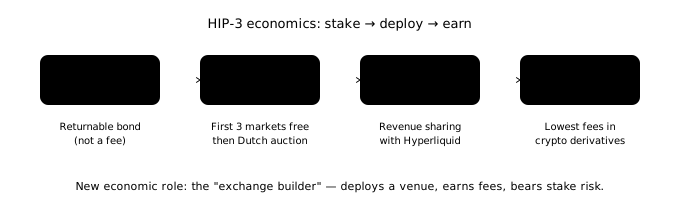
Here's what I found. The 500K HYPE stake isn't a fee -- it's a returnable security bond. If you operate honestly and eventually close your markets, you get it back (after a 30-day holding period post-halt, plus a 7-day unstaking queue). During all of that time, the stake remains slashable by validators if you misbehave. Think of it as a deposit, not a payment. (Hyperliquid Docs)
Each deployer gets their first three markets free. Additional markets go through a Dutch auction with 31-hour cycles. Early auctions have been cheap -- deployers paid roughly 500 HYPE each for tickers like GOLD and HOOD.
The revenue model: deployers earn up to 50% of all trading fees from their markets. Base fees start at 2x the standard Hyperliquid rate (3/9 basis points maker/taker). And there's a "Growth Mode" that lets deployers slash taker fees by over 90% -- from 0.045% down to 0.0045% -- creating some of the lowest trading costs in all of crypto derivatives. For strategies like the cash-and-carry trade, where fee breakeven is a real constraint, these rates change the math significantly. Growth Mode is restricted to non-crypto assets, so it can't cannibalize Hyperliquid's existing markets. (Yellow)
FalconX projected that if HIP-3 deployers captured even a fraction of traditional asset derivatives volume -- less than 1% of Magnificent Seven stock derivatives -- the incremental fee revenue could reach $800 million annualized. (FalconX)
The math is speculative but the direction is clear: there's a new economic role in DeFi -- the "exchange builder" -- and HIP-3 created it.
Five Deployers, Five Different Bets

What happened after launch surprised me. I expected crypto-adjacent assets -- maybe tokenized stocks, a few indices. What actually materialized is more diverse and more interesting.
Trade.xyz was the first deployer, going live on launch day. Their flagship: XYZ100, tracking the top 100 US non-financial companies. They hit $1.3 billion in cumulative volume within three weeks. By March 2026: over $100 billion cumulative, $1.58 billion in open interest, and a peak day of $5.6 billion in volume with 45,300 unique traders. Then came the headline: S&P Dow Jones Indices officially licensed the S&P 500 index to Trade.xyz -- the first time a major index provider licensed to a DEX for perpetual contracts. (S&P Press Release; The Block)
Aura went after commodities and bonds. WTI oil, Brent crude, gold, silver, US Treasuries. This turned out to be the breakout category. Oil and precious metals accounted for over 67% of all HIP-3 volume in Q1 2026. The driving force wasn't what I expected -- it's the 24/7 angle. Commodities traditionally have market hours. Crude oil trades on NYMEX for about 23 hours a day with a gap. Gold has a similar schedule. On Hyperliquid, these markets never close. For commodity traders, that's the killer feature.
Felix launched the first HIP-3 equity perpetual -- TSLA -- on November 13, 2025, powered by RedStone's HyperStone oracle. By March 2026, they'd expanded to over 250 tokenized US stocks and ETFs.
Ventuals carved out a niche in pre-IPO equities -- synthetic perps on private company valuations like OpenAI, SpaceX, and Cursor. Speculation on companies before they go public, settled entirely on-chain.
Trove might be the most unexpected. They raised $20 million specifically to purchase HYPE for their deployment stake, then launched perpetual futures on Pokemon cards. Collectibles as a tradeable derivatives asset class. I didn't see that coming.
As of late March 2026, total HIP-3 open interest stood at $1.74 billion -- growing 25% week-over-week. Only 7 of the top 30 Hyperliquid markets by open interest were crypto pairs. The rest: oil, gold, indices, equities. (The Block; CryptoTimes)
The Oracle Problem (And Why It Keeps Me Up)
Here's where I got nervous.
Hyperliquid's validator-operated perps use the oracle system I documented in the exchange architecture piece -- a multi-layered stack of weighted medians across eight exchanges, validated through consensus. Robust, proven, battle-tested against the JELLY attack.
HIP-3 markets don't use that oracle. They can't -- they track assets that don't trade on those exchanges. Oil doesn't have an on-chain spot market. S&P 500 doesn't have a cross-exchange median. So HIP-3 deployers must bring their own oracles.
RedStone built HyperStone specifically for this. It's a three-tier architecture: a Proposer aggregates prices from external sources, 10 Oracle Nodes independently verify them (rejecting updates that deviate more than 1%), and a Relayer publishes on-chain within 2.5-3 seconds. Byzantine fault tolerance with a 3-of-5 signature requirement. Over 1,300 assets from 50+ data sources, infrastructure collocated in Asia near Hyperliquid's nodes. (RedStone Blog; The Block)
But not all deployers use HyperStone. Oracle selection is the deployer's choice. And the Hyperliquid docs state it plainly: "Oracle design is completely general at the protocol level." That's the freedom that makes HIP-3 powerful. It's also the attack surface.
The ghost in the room is Mango Markets. In 2022, a trader manipulated a thin oracle price feed on Mango and drained $112 million. That attack would be harder on HIP-3 -- the $20M+ staking bond creates real deterrence -- but the fundamental vulnerability is the same. If an exotic asset has limited price transparency and the deployer's oracle isn't robust, a brief manipulation window could exist before validators detect and act.
I don't know how to fully assess this risk. Nobody does yet. There hasn't been a major oracle exploit on HIP-3. The security model is empirically unproven under adversarial conditions for exotic assets. That's not a criticism -- it's just the honest state of things five months in.
Security by Punishment, Not Prevention
This is the part of HIP-3's design that I found most philosophically interesting.
Traditional exchanges prevent bad markets from existing. A listing committee reviews each asset. Quality control happens at the gate. HIP-3 takes the opposite approach: let anyone create a market, and punish bad behavior after the fact.
The mechanism is validator slashing. Hyperliquid's validators can vote to slash a deployer's stake on a tiered scale: up to 20% for minor issues like performance degradation, up to 50% for moderate issues like brief downtime, and up to 100% for critical issues like invalid state transitions or prolonged outages. (Hyperliquid Docs)
One design choice I found elegant: slashed funds are burned, not redistributed. This removes the moral hazard of validators profiting from slashing. There's no financial incentive to over-punish.
Cross-margin safeguards add another layer. Enabling cross-margin on a HIP-3 asset is irreversible and requires the asset to pass tests for observable liquidity, oracle reliability, and manipulation resilience. Assets with daily moves exceeding 50% more than monthly are permanently barred. This limits how much a single HIP-3 market can contaminate the broader system.
The honest assessment: this is a reactive model, not a preventive one. Damage can occur before validators detect it. The question is whether the $20M+ security bond provides enough deterrence to make attacks uneconomic. So far, it has. But "so far" is five months.
The Bigger Stack
Stepping back, what struck me most is that HIP-3 isn't an isolated feature. It's one layer in a deliberate progression:
- HIP-1: Anyone can create a token and it automatically gets an on-chain spot order book
- HIP-2: A decentralized market-making strategy built into the chain itself, providing liquidity to HIP-1 tokens
- HIP-3: Anyone can create perpetual futures markets for any asset
- HIP-4 (on testnet as of March 2026): Permissionless prediction and outcome markets
(Hyperliquid Docs: HIP-1; HIP-2; CoinDesk)
Each HIP widens what can be traded on Hyperliquid without anyone's permission. Tokens, then liquidity for those tokens, then derivatives on any asset, then prediction markets. The direction is clear: Hyperliquid is building toward a state where any financial product can be created by anyone, running on shared infrastructure.
This is different from what I documented in the perps article about the CEX vs DEX architecture split. That was about where the machine runs -- centralized servers vs on-chain consensus. HIP-3 adds a new dimension: who gets to deploy the machine.
On a CEX, the exchange decides what you can trade. On a DEX like pre-HIP-3 Hyperliquid, the protocol team decides. On HIP-3 Hyperliquid, the answer to "who decides what's tradeable" is "nobody." Anyone with the stake can deploy. The market decides what survives.
What I'm Still Uncertain About
I want to be direct about the things I couldn't resolve.
Deployer concentration is extreme. Trade.xyz holds $1.58 billion of the $1.74 billion total HIP-3 open interest (as of late March 2026). That's over 90%. Whether other deployers achieve sustainable volume is genuinely uncertain. One dominant deployer isn't a "market factory" -- it's one successful restaurant in a commercial kitchen.
The cold-start problem is real. HIP-3 markets don't share liquidity with HLP or the existing Hyperliquid pool. Each deployer bootstraps from scratch. The top markets -- oil, gold, S&P 500 -- overcame this through sheer demand and aggressive fee cuts. But long-tail assets (pre-IPO equities, bonds, collectibles) face uncertain sustainability. Without natural trading flow, markets die once incentives dry up. (Bankless)
Regulatory territory is uncharted. The S&P 500 licensing deal is a strong signal of institutional legitimacy. But permissionless creation of equity and commodity derivatives sits in a regulatory gray zone. No regulatory body has explicitly addressed HIP-3-style market creation. The "builder" role -- someone who deploys a derivatives venue but isn't a broker, exchange, or market maker in any traditional sense -- has no equivalent in existing financial regulation.
All the numbers in this piece are snapshots. HIP-3 market data moves fast. The $1.74B OI, the volume figures, the deployer rankings -- these are from late March 2026 and will look different by the time you read this. I've tried to describe trajectories rather than frozen moments, but treat specific figures as directional indicators, not gospel.
What I Came Away With
I started this trying to understand a protocol upgrade. What I found is something closer to a paradigm shift in how derivatives markets get created.
The traditional model -- an exchange or committee decides what you can trade -- has been the default for centuries. It works. Quality control at the gate prevents a lot of garbage from reaching traders. But it also means someone is always deciding, and those decisions come with politics, fees, and delays.
HIP-3 proposes a different answer: replace the gatekeeper with a security bond and let the market sort it out. It's the same philosophical move as Bitcoin (replace the bank with math) or Uniswap (replace the listing committee with a liquidity pool), applied to the question of market creation itself.
The early results are striking. $1.74 billion in open interest, $100 billion+ in cumulative volume, an official S&P 500 license, and a commodity-led demand surge that nobody predicted -- all within five months. But the risks are equally real: unproven oracle security on exotic assets, extreme deployer concentration, and a regulatory landscape that hasn't even begun to grapple with permissionless derivatives creation for traditional assets.
What surprised me most: the instrument I wrote about in my first perps article -- designed by Shiller for housing markets, adopted by crypto for 24/7 trading -- is now being used for crude oil on a permissionless blockchain exchange. The perps-escaping-crypto thesis is being executed, and HIP-3 is the mechanism.
Whether the "market factory" model beats the "gatekeeper" model in the long run, I genuinely don't know. The answer probably depends on whether the reactive security model holds up under a real attack, whether deployer diversity materializes beyond Trade.xyz, and whether regulators decide this is innovation or a problem.
Meanwhile, the DeFi layer built on top of perps keeps deepening. Ethena turned the delta-neutral trade into a stablecoin backed by the same shorts running on these engines. Pendle tokenizes yield into fixed income, including Ethena's sUSDe. And Boros makes funding rates themselves tradeable — a derivative of a derivative, built one abstraction layer above the funding engine that HIP-3 markets inherit.
And now there's HIP-4 — the first HIP that deliberately removes leverage. Fully collateralized outcome contracts, co-authored with Kalshi, settling binary events without funding rates, liquidations, or margin calls. It's a different class of derivative than everything above, and it's the subject of the next piece.
That's what I know. Hoping it saves you a few rabbit holes.