
I mentioned Ethena in passing in both my funding rate piece and my cash-and-carry article. In the funding rate article, I called it "funding rate securitization." In the carry piece, I described the self-limiting dynamic — more demand, more shorting, lower yields.
But I never explained how it actually works. The minting. The hedging. The vault. The reserve fund. What happens when funding goes negative. What happened in October 2025 when USDe hit $0.65 on Binance.
I spent the last while inside Ethena's docs, governance forum, and three independent risk assessments. What I found is more sophisticated than I expected — and the most interesting part isn't any single mechanism. It's how they all interact to create a system that regulates itself in ways the designers didn't fully plan for.
Start Here: What USDe Actually Is
USDe is not a stablecoin. I don't mean that in a pedantic way — I mean it legally cannot be called one. Under the GENIUS Act (signed July 2025), the EU's MiCA framework, and Singapore's stablecoin rules, a "stablecoin" must be backed by cash or cash equivalents. USDe is backed by derivatives positions. BaFin already barred it in the EU.
Ethena calls USDe a "synthetic dollar." The distinction is not just branding — it's the reason USDe can offer yield when USDC can't. Regulated stablecoins are restricted in how they distribute reserve income. USDe, by operating outside stablecoin regulations, passes yield directly to holders. That regulatory arbitrage is both its competitive advantage and its existential risk.
OK, mechanics. Here's how a dollar of USDe comes into existence.
The Minting Machine
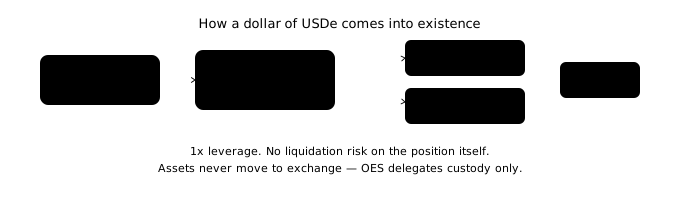
You can't mint USDe. Not directly. Only whitelisted entities — KYC-screened, in permitted jurisdictions — interact with Ethena's smart contracts. Retail users buy and sell USDe on secondary markets (DEXs, CEXs). The whitelisted minters are the arbitrage layer that keeps the price near $1.
When a minter deposits collateral (USDT, USDC, ETH, stETH, BTC), the protocol does two things atomically:
- Mints an equivalent dollar amount of USDe
- Opens a short perpetual position for the same notional value on a derivatives exchange
Deposit $100 of USDT, receive ~100 USDe, and somewhere on Binance, Bybit, or OKX, a $100 short perp position opens. Redemption is the reverse: USDe goes in, the short position closes, collateral comes out.
I wrote about the delta-neutral trade at length — spot long plus perp short equals zero directional exposure. Ethena runs this at 1x leverage (no effective leverage), making standard liquidation essentially impossible. The math is the same as the cash-and-carry setup I covered, so I won't repeat it here.
What's different from a manual cash-and-carry is the custody architecture. This is the part I didn't appreciate until I read the docs.
Off-Exchange Settlement (OES)
Before FTX collapsed, running a delta-neutral strategy meant putting your collateral on an exchange and hoping the exchange didn't go under. Post-FTX, Ethena solved this with off-exchange settlement providers: Copper ClearLoop, Ceffu MirrorX, Anchorage, and Kraken.
The assets never actually move to the exchange. Ethena delegates custody — not transfers it — to CEXs for margin purposes. The only thing flowing between custody and exchange is P&L settlement. Copper settles every 4 hours. Ceffu settles at T+1.
Real-world validation: when Bybit got hacked in February 2025 and lost $1.4 billion, Ethena's total Bybit exposure was under $30 million — just hours of P&L, not the full collateral stack. The OES architecture contained the damage.
This distinction matters because it transforms the risk profile. The cash-and-carry trade's biggest vulnerability — "your money is on the exchange" — is structurally removed. What replaces it, as I'll get to, is a different kind of risk entirely.
The sUSDe Vault: Where Yield Happens
Here's where it gets interesting. USDe by itself is just a synthetic dollar — it doesn't earn anything. To get yield, you stake USDe into the StakedUSDe contract and receive sUSDe tokens.
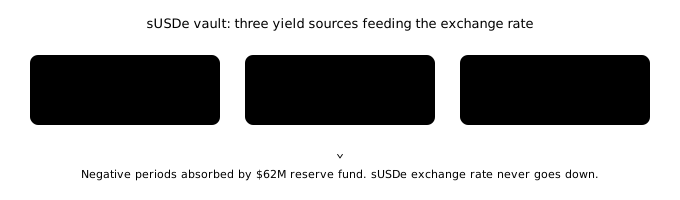
sUSDe uses the ERC-4626 vault standard — a well-understood pattern in DeFi. Yield accrues by increasing the exchange rate between sUSDe and USDe. Your token count stays the same; each sUSDe simply represents more USDe over time. No new tokens are minted for rewards.
Three sources feed that rising exchange rate:
1. Perpetual funding rates — the primary driver. When funding is positive (which it historically is on the majority of days), Ethena's short positions collect payments from longs. This was running ~11% annualized in 2024, ~5% in 2025, and ~3.5% as of March 2026 (Coin Metrics).
2. ETH staking rewards — from staked ETH (stETH and similar) held as collateral. Consensus and execution layer rewards add roughly 3% annualized. This matters because it provides a yield floor even when funding goes negative.
3. Stablecoin and Treasury interest — USDC interest, plus exposure to US Treasuries via BlackRock's BUIDL fund through Ethena's USDtb product. This is the baseline layer: when funding rates compress toward zero, Treasury yield (~4-5%) prevents sUSDe from earning nothing.
The critical design choice: sUSDe holders only receive positive or flat rewards. Negative periods — when combined revenue turns negative — are absorbed by the reserve fund. You never see your sUSDe exchange rate go down.
The historical yield range tells a story:
| Period | sUSDe APY |
|---|---|
| Launch (Feb 2024) | ~27% |
| Early 2024 peak | 60%+ |
| 2024 stabilized | ~19% |
| 2025 range | 4-15% |
| March 2026 | ~3.5-3.7% |
That's not a random walk. That compression follows a structural pattern I'll come back to.
Unstaking
Originally, unstaking had a fixed 7-day cooldown — you request, your USDe goes into a silo contract, and you withdraw after a week. As of March 2026, the cooldown became dynamic: 1-7 days depending on how much liquid stablecoin sits in USDe's reserve. More liquidity means shorter waits.
The Reserve Fund: Insurance Against Bad Days
This is the piece that makes the "sUSDe never goes negative" promise possible.
The reserve fund stands at $62 million (as of February 2026), held primarily in USDtb ($41.93M) and a USDtb/USDC liquidity pool ($19.99M). USDtb itself is 90%+ backed by BlackRock's BUIDL tokenized Treasuries — so the reserve earns Treasury yield while it sits there.
Three independent risk assessments placed the required minimum between $17-23M. The fund is roughly 3x the tail-risk requirement. The Risk Committee's assessment: "remains oversized and is sufficient."
How bad can it get? LlamaRisk's V2 drawdown methodology models the worst case: all perpetual positions closing within 24 hours, 0.5% funding losses, 75bps worst-case slippage with orders capped at $25M tranches. Under that extreme scenario, $63.6M is recommended. The current $62M is close to that ceiling.
The V1 methodology gives a starker number: at sustained -10% funding with 10bps slippage and 0.5% daily redemptions, the fund depletes in 33 days. The longest historical negative funding streak? 13 days. So the fund is calibrated to survive roughly 2.5x the worst observed period.
But here's the detail that impressed me: the reserve fund was not drawn upon during October 2025. At all. The protocol processed $1.9 billion in redemptions — 13% of USDe's $14.6B market cap at the time — without operational losses. Normal redemption mechanics handled everything.
The Reflexivity Loop (This Is the Real Story)
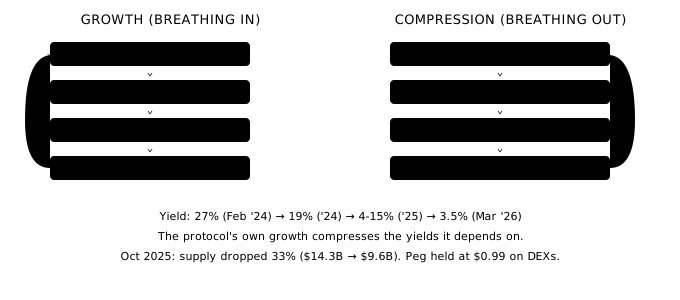
Everything above describes the parts. Now here's how they interact — and this is what made me rethink my initial framing of Ethena as "just a cash-and-carry trade in a wrapper."
The system has a built-in feedback loop that both accelerates growth and enforces contraction. I'll walk through both directions.
The Growth Flywheel
Crypto rally → funding rates rise → sUSDe yields rise →
more demand to mint USDe → more short positions opened by Ethena →
more funding collected → higher yields → more demand → ...
This cycle ran hot through 2024 and into 2025. USDe supply increased $3 billion in just 20 days during one bullish stretch. Annualized protocol fees exceeded $439 million (as of July 2025). sUSDe yield hit 60%+ at the early 2024 peak.
The Compression Brake
Here's what happens next — and this is the part nobody in the yield threads seems to mention:
More USDe demand → more short positions opened →
total short supply increases → funding rates compress →
sUSDe yields drop → demand for USDe falls →
supply contracts → short positions closed → funding recovers
The protocol's own growth compresses the yields it depends on.
I covered this dynamic in my funding rate article in the "Floor and Ceiling" framework — when arb capital floods into the short side, funding compresses. Ethena is the single largest source of that arb capital. The protocol IS the ceiling.
The data traces a clean arc. Average funding rates: ~11% annualized in 2024, ~5% in 2025, ~3.5% in early 2026. USDe supply: peaked at $14 billion (October 2025), then contracted to $5.9 billion by March 2026. The compression mirrors what happened when too much institutional capital entered the CME basis trade — same dynamic, same outcome.
The Contraction Spiral
The downside version of the loop is sharper:
Market downturn → funding turns negative → sUSDe yields drop →
leveraged strategies become unprofitable → mass redemptions →
USDe supply contracts → Ethena closes short positions →
reduced shorting → funding may recover → cycle resets
October 2025 was the live demo. USDe supply dropped from $14.3B to $9.6B — a 33% contraction. Funding fell from double digits to 5.1% APR. That 5.1% was critically below the USDC borrow rate on Aave (5.4%), which triggered the unwinding of the leverage loops I'll describe next. ENA (Ethena's governance token) dropped 60%.
Why This Isn't Terra
I know what you're thinking. Reflexive loop. Yield compression. Supply contraction. Sounds like Luna/UST.
The difference is where the reflexivity lives. Terra's death spiral was in the peg mechanism itself — UST was backed by LUNA, LUNA's value came from UST demand, and when confidence broke, both went to zero. Circular dependency with no external backing.
Ethena's reflexivity is in the yield, not the peg. When USDe demand drops, supply contracts and yields fall — but each remaining USDe is still backed by a real delta-neutral position (spot + short perp) plus reserves. The peg mechanism stays intact even when yields compress. October 2025 proved this: yields cratered, supply contracted by billions, but the protocol-level peg held at $0.99 on DEXs.
The USDe price that hit $0.65? That was a Binance-specific oracle distortion — their internal price methodology briefly diverged during extreme volatility. It was below $0.90 for only 23 minutes. DEX pools (Fluid, Curve, Uniswap) maintained pricing around $0.99 throughout. Protocol redemptions processed at $1 parity.
The Leverage Tower Built on Top
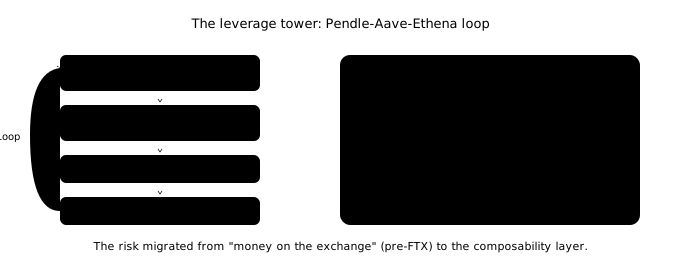
This is the risk I found most alarming — and it's not inside Ethena. It's what DeFi built on top of it.
The loop works like this:
- Lock sUSDe in Pendle to mint fixed-rate PT-sUSDe tokens
- Deposit PT-sUSDe on Aave as collateral
- Borrow stablecoins from Aave
- Use borrowed stables to mint more USDe
- Convert to sUSDe
- Repeat
At peak, this strategy locked $4.2 billion of sUSDe in Pendle PT tokens, looped through Aave. I wrote a detailed breakdown of how Pendle's yield tokenization works -- including the PT/YT split, the time-aware AMM, and why this loop became the dominant yield strategy in DeFi. It accounted for roughly 60% of USDe's total supply. Aave held $4.7 billion in USDe-backed assets — 55% of USDe's entire market cap sitting in one lending protocol.
The math was attractive: PT-sUSDe fixed yield around 12-13% versus Aave borrow rates of 5-7%. That's a 5-6% net spread per loop, and you could loop multiple times.
Chaos Labs warned that a 20% crypto price drop could trigger $1.2 billion in liquidations from these loops. The system has natural counter-flows — unwinding repays stablecoins to Aave, reducing utilization rates — but if redemptions accelerate while Aave is already strained, what Aave's governance forum described as "a manageable deleveraging cycle" could flip into "a systemic liquidity crunch."
This is the risk migration pattern I keep seeing. Pre-FTX, the danger was "your money is on the exchange." Ethena's OES architecture largely solved that. But the risk didn't disappear — it moved to the DeFi composability layer. (If you want to understand the exchange-level mechanics underlying Ethena's short positions — the matching engine, clearinghouse, and liquidation waterfall — that's the infrastructure piece.) $4.7B in Aave, 60% of supply in Pendle loops. The seam between Ethena, Pendle, and Aave is where the stress concentrates now.
The Dynamic Allocation (What Most People Miss)
One thing I didn't know until I read the docs: Ethena doesn't maintain a fixed ratio of perps to stables in its backing. The allocation shifts based on market conditions.
When funding rates are high, more collateral backs delta-neutral perp shorts — that's where the yield is. When funding compresses or goes negative, the protocol shifts toward liquid stablecoins earning Treasury rates via BlackRock's BUIDL fund.
The result of this was dramatic. At the start of 2025, perpetual futures represented 93% of USDe's backing. After the October 2025 contraction, perps dropped to just 11%. The remaining 89% shifted to stablecoins and lending.
This dynamic allocation is why the reserve fund survived October untouched. The protocol didn't passively sit through negative funding — it actively reduced perp exposure. But it also means that in low-funding environments, sUSDe yield converges toward Treasury rates (roughly 4-5%). The high yields that attracted users in the first place require bull-market funding conditions.
What I'm Still Uncertain About
I want to be honest about the edges of my understanding.
Can funding rate risk be hedged away? Boros -- Pendle's interest rate swap platform -- lets protocols lock in fixed funding income by shorting yield units. If Ethena were to hedge its funding exposure through Boros, the yield would become predictable but lower. Whether the protocol adopts this or continues bearing floating rate risk is an open strategic question.
How long can the reserve fund survive a truly extended bear? The longest observed negative funding streak is 13 days. The V1 drawdown model says depletion at 33 days under -10% funding. We've never seen a 60-day sustained negative funding environment. The models say the fund should hold. Models also said a lot of things before 2008.
The regulatory endgame is genuinely unknown. The GENIUS Act is law, but the regulations are still being drafted (due July 2026). Whether USDe gets forced to restructure, exit the US market, or carve out an exemption — nobody knows yet. Ethena is building toward institutional access through iUSDe (compliance wrappers) and the Converge blockchain (co-developed with Securitize), but these are pre-launch. Whether TradFi demand materializes is speculative.
The backing composition is not fully transparent. Ethena's docs describe the dynamic allocation model, but the protocol doesn't publish real-time breakdowns of perp-vs-stable backing ratios. The data points I've cited (93% perps, 11% perps) come from Coin Metrics analysis, not from Ethena directly.
Is the structural shift temporary or permanent? The move from 93% perp backing to 11% could be a market-condition response that reverses when funding recovers. Or it could be a permanent strategic pivot toward a more conservative model. The implications for future yield are very different depending on which it is.
Thesis: The Self-Regulating Machine
Here's what I came away with after pulling all of this apart.
Ethena is not "the next Terra" and it's not "risk-free yield." It's something more nuanced and more interesting: a self-regulating mechanism where the yield signal, the supply, and the risk all move together in a feedback loop.
High funding markets make sUSDe attractive. That attracts capital. Capital grows the supply. Growing supply compresses funding. Compressed funding makes sUSDe less attractive. Capital leaves. Supply contracts. Contracted supply reduces shorting pressure. Funding may recover. The machine breathes in and out.
The peg survived October 2025 not because nothing went wrong, but because the mechanism is designed to handle contraction. Redemptions processed. The reserve fund held. The protocol shrank by a third and kept functioning. That's a meaningful validation.
The real risk isn't inside Ethena's core mechanism — it's in the leverage tower built on top. The Pendle-Aave loops that amplified sUSDe yield also amplified the contraction dynamics. When yields dropped below borrow rates, the unwind was swift and large. The system has stabilizing counter-flows, but the interaction between Ethena, Pendle, and Aave during severe stress is the scenario that keeps risk analysts up at night.
And then there's the slow structural question: as Ethena's own growth compresses the funding rates it depends on, and as competition enters the space, sUSDe yield converges toward Treasury rates. At ~3.5% (as of March 2026), USDe is approaching the point where the complexity premium — the extra risk you take versus simply holding Treasuries or USDC — needs justification. Whether the next bull market reflates the cycle or whether yield stays compressed is the open question.
What I find most instructive is that Ethena is the purest demonstration of something I've been writing about across multiple articles: the reflexivity of yield in crypto markets. The same dynamic that compresses the CME basis trade, that drives funding rate cycles, that shapes how arb capital flows in the perpetual markets — it's all one system. Ethena just made it visible by packaging it into a single token with a rising exchange rate.
That's what I know. Hoping it saves you a few rabbit holes.