
Every headline got it wrong.
When Hyperliquid posted about HIP-4 on February 2, 2026, the crypto press converged on one frame: "Hyperliquid enters prediction markets." CoinDesk led with the HYPE pump. CoinGecko compared it to Polymarket. HYPE rallied over 10% in a day on the narrative alone.
I read the headlines and thought the same thing. Another exchange ships another prediction market. Got it. So what is HIP-4, actually?
Then I read Hyperliquid's actual words. Not "prediction market." Not "outcome platform." The phrase they kept using was "general-purpose primitive." And the three adjectives they paired with it: "fully collateralized," "no leverage," "no liquidations."
I had to re-read it three times. I'd just spent four articles — on funding rates, perpetual futures, how Hyperliquid's engines work, and HIP-3's market factory — explaining the machinery that makes leveraged derivatives possible. Funding rates. Maintenance margin. ADL. Liquidation cascades. HLP backstop vaults. All of that complexity exists because leverage creates risk that has to be managed in real time, every block.
HIP-4 removes all of it.
What I Missed (And Who Actually Co-Authored This)
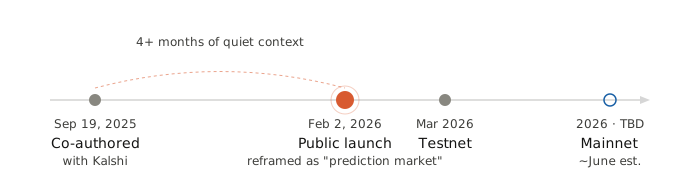
Here's what most coverage skipped. HIP-4 was not invented on February 2, 2026. It was co-authored by John Wang of Kalshi and first announced on September 19, 2025 — more than four months before the public framing.
Kalshi is not a random crypto startup. It's the CFTC-regulated prediction market platform in the United States — the one that survived legal battles with the Commodity Futures Trading Commission to become officially recognized as a designated contract market. That legal status is scarce, expensive, and took years to obtain.
When I learned that Kalshi co-authored HIP-4, the design started making sense in a way it hadn't before. This isn't Hyperliquid building a Polymarket clone. This is a regulated prediction market infrastructure landing on-chain for the first time. And several design choices that seemed arbitrary suddenly looked deliberate:
- Fully collateralized, no leverage — regulated US event contracts are fully paid for, not leveraged. This mirrors Kalshi's existing CFTC-approved structure.
- Binary settlement only — matches how Kalshi lists event contracts today.
- Authorized oracle with challenge window — mirrors Kalshi's designated resolution authority model, not a decentralized oracle network.
- Canonical markets first, permissionless later — lets the regulated partner go first.
The editorial frame that everyone else used — "Hyperliquid vs. Polymarket" — collapses under this context. The frame should be: Hyperliquid and Kalshi are building the infrastructure for regulated event contracts to settle on-chain. Prediction markets are one product on top of that infrastructure. Not the infrastructure itself.
What Is HIP-4? Understanding Outcome Contracts
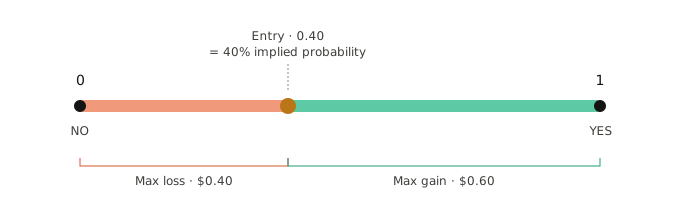
Hyperliquid HIP-4 is a protocol for outcome trading — binary derivatives (also called event perpetuals) that trade between 0 and 1, settle at a fixed expiry, and require no leverage, no margin, and no liquidation engine.
Strip away the framing, and the mechanism is simple.
An outcome contract is a binary instrument. It trades between 0.001 and 0.999 — the price represents the market's implied probability that a specific event will happen. At expiry, an authorized oracle posts the result: the contract settles to exactly 1 (event occurred) or 0 (event did not occur). All settlement in USDH.
Buy "BTC above $150K by June" at 0.40. You post $0.40 per contract — that's your maximum loss. If BTC crosses $150K, you receive $1.00. If it doesn't, you lose your entry. No margin calls. No liquidation. No funding rate ticking against your position overnight.
This is what makes HIP-4 a different class of derivative from everything else on Hyperliquid:
| Perpetual Futures (HIP-3) | Outcome Contracts (HIP-4) | |
|---|---|---|
| Leverage | Up to 50x | None (1x isolated) |
| Funding rate | Yes — paid every hour | No |
| Liquidation | Yes — margin can be seized | No — max loss = entry cost |
| Maintenance margin | Yes | No |
| ADL (auto-deleverage) | Yes | No |
| Expiry | None (perpetual) | Fixed date |
| Payoff range | Unbounded | Bounded [0, 1] |
Every row in the left column exists because leverage creates risk that must be contained. HIP-4 doesn't need any of it, because bounded payoff with a known maximum loss eliminates the conditions that make liquidation necessary.
Why Removing Leverage Is the Entire Point
I want to stay on this for a moment, because it's counterintuitive.
If you've followed Hyperliquid through the previous four articles, everything has been about leverage machinery. Funding rates exist because leveraged perps need an anchor to spot price. Maintenance margin and ADL exist because leveraged positions can go underwater. HLP exists as the backstop vault that absorbs liquidations when the insurance fund runs dry. HIP-3 let anyone deploy new leveraged markets for new assets — commodities, indices, equities, even Pokemon cards.
HIP-4 is the first time Hyperliquid shipped a derivative that doesn't need any of that. And the reason is structural, not accidental:
A perpetual future has unbounded loss (theoretically, a short can lose infinity). To prevent insolvency, the system must monitor positions in real time and force-close them before the collateral runs out. That monitoring — funding rates, maintenance margin, liquidation engines, ADL, insurance funds — is the majority of what makes a derivatives exchange complex.
An outcome contract has bounded loss (at most $1 per contract). If you buy at 0.40, you can lose 0.40. That's it. There is no scenario where you owe more than you posted. So there's nothing to monitor, nothing to force-close, nothing to backstop.
The absence of leverage isn't a limitation. It's the thing that makes the mechanism simple enough to be a true primitive.
When Will HIP-4 Launch on Mainnet?
HIP-4 mainnet launch is expected within 2026, with no specific date confirmed. As of April 2026, HIP-4 is live on testnet only. Arthur Hayes reportedly estimated launch would happen within three months of March 2026, placing it around June.
Hyperliquid's rollout follows the same two-phase pattern as HIP-3:
- Phase 1 — Canonical markets: team-curated markets (likely Kalshi-operated) with authorized oracles, denominated in USDH
- Phase 2 — Permissionless: 1M HYPE staking opens builder deployment to any participant
Testnet has been live since February 2026 with BTC and HYPE daily binaries plus recurring 15-minute price markets in the Predict panel. No specific mainnet launch date or criteria have been published.
HIP-4 Beyond Prediction Markets
While many frame this as Hyperliquid prediction markets, Hyperliquid itself calls HIP-4 a "general-purpose primitive." The prediction-market surface product is the most obvious use case, but the mechanism supports more:
- Binary event contracts — "Fed cuts rates in July," "ETH ETF approved by Q3," "candidate X wins election"
- Bounded options-like instruments — knock-in / knock-out style payoffs within a fixed range
- Insurance-like payoffs — hedge against a tail event by buying the corresponding YES contract
- Multi-outcome questions — implemented as multiple independent binary contracts. On testnet, a multi-choice question like "What will Hypurr eat?" breaks into one binary per candidate:
akami-yes,canned-tuna-yes, etc. The protocol stays simple; the product layer composes.
The primitive is always the same: a contract that lives inside a fixed range and converges to its truth at a known expiry. What you build on top of it depends on what event you point it at and how you compose the binaries.
This is the same pattern as HIP-3. HIP-3 turned "market creation" into an abstraction — anyone could deploy a perpetual market for anything. The surprising outcome was crude oil and commodities, not the things anyone predicted. HIP-4 turns "binary settlement" into an abstraction. The surprising use cases probably haven't been imagined yet.
Where the Price Discovery Lives
Perpetual futures discover the price of leverage demand via funding rates. When longs outnumber shorts, the funding rate ticks positive — longs pay shorts — until the imbalance resolves. I covered this mechanism in detail in the funding rate piece.
Outcome contracts don't have funding rates. So what does the price discover?
Implied probability. The bid-ask spread of a binary contract is the market's real-time consensus on whether an event will happen. A contract trading at 0.72 means the market believes there's a 72% chance the event occurs. As new information arrives — a Fed statement, a protocol upgrade, a whale trade — the price adjusts, and the implied probability shifts.
This is its own kind of information product. Polymarket proved that prediction market prices are valuable signals — not just for traders, but for analysts, journalists, and decision-makers who want to know what the crowd really believes (as opposed to what pundits say). HIP-4 puts that same price discovery mechanism inside Hyperliquid's order book, where it can be composed with other instruments.
Why HIP-4 Lives in HyperCore
Hyperliquid didn't build HIP-4 as a dApp on HyperEVM. They put it inside HyperCore — the same execution layer that runs the perps order book and the spot market.
This means:
- Same matching engine. Outcome contracts trade on the same order book infrastructure as perps — same latency, same throughput.
- Same margin account. A trader can hold a long ETH perpetual, a spot HYPE position, and a "BTC above $200K" outcome contract in the same account. The system recognizes all three and calculates net exposure accordingly.
- Same settlement rail. All HIP-4 contracts settle in USDH — Hyperliquid's native stablecoin, fully reserved and backed by cash, cash equivalents, and US Treasuries through partnerships with Stripe, Fireblocks, J.P. Morgan, BlackRock, and Superstate.
Builder deployment requires 1,000,000 HYPE staked — double the HIP-3 threshold of 500K. Slashed tokens are burned. A single 1M HYPE stake supports a rolling series of markets through slot recycling — you don't need new capital for every new contract.
The doubling of the stake and the burn mechanic both signal the same thing: outcome contract oracles carry more risk than perp market oracles (because there's no external spot price to arbitrage against), so the economic deterrent has to be stronger.
Canonical Markets First, Then Permissionless
Hyperliquid is running the same playbook as HIP-3: curated canonical markets first, open the gates second.
Phase 1 — canonical markets — will be team-curated (and likely Kalshi-operated), denominated in USDH, with authorized oracles and objective settlement sources. This is the trust-bootstrapping phase: prove the mechanism works under controlled conditions.
Phase 2 — permissionless builder deployment — opens it up to any 1M HYPE staker. Just like HIP-3 opened the door for Aura (commodities), Trade.xyz (indices), and Trove (Pokemon cards), Phase 2 of HIP-4 will let builders create outcome contracts for anything they can source an oracle for.
The pattern is becoming a recognizable Hyperliquid strategy. Launch curated to build trust. Open up to build scale. HIP-3 did this with builder-deployed perps and the result was categories nobody expected — crude oil became the most-traded non-crypto asset on any DEX. HIP-4 will probably surprise in the same way.
What Hyperliquid Hasn't Said Yet
I want to be honest about the gaps.
No documentation page. As of mid-April 2026, Hyperliquid's GitBook has dedicated pages for HIP-1, HIP-2, and HIP-3. HIP-4 has nothing. Every article being written about it — including this one — works from the February announcement, testnet observation, and secondary coverage. There is no spec to read.
Binary only. The "general-purpose primitive" framing implies range markets with non-binary outcomes (settling to values between 0 and 1). That math hasn't shipped. Only binary YES/NO contracts exist on testnet. The range-market settlement mechanism is either unbuilt or unpublished.
Oracle specifics unclear. The mechanism names an "authorized oracle" with a challenge window, but who will resolve canonical markets? Kalshi? Hyperliquid validators? A third-party data provider? The identity of the resolver matters enormously for trust, and it's not disclosed.
Mainnet date. Official: "within 2026." Arthur Hayes reportedly estimated "within three months" from March, which would put it around June. No specific date or criteria have been published.
Fee structure. HIP-3 has a clear 50/50 fee split between deployers and protocol. HIP-4's fee model hasn't been detailed.
Kalshi's operational role. The Kalshi co-authorship is confirmed, but what exactly Kalshi does on mainnet — oracle operator, canonical market deployer, regulatory compliance layer — remains undisclosed.
These aren't criticisms. The testnet has been live for about five weeks. Hyperliquid ships fast and documents later. But if you're evaluating HIP-4 as infrastructure rather than hype, these open questions are the ones to watch.
What Clicked
HIP-3's central thesis was: "HIP-3 is not about liquidity. It's about who gets to create markets."
HIP-4 deserves a parallel framing: HIP-4 is not about prediction markets. It's about what a derivative can be when you remove leverage from the primitive.
Across four prior articles, I've been walking through the machinery that makes leveraged, perpetually-settled derivatives possible. Funding rates. Liquidation engines. Insurance funds. ADL. HLP. The JELLY incident. All of it exists because leverage creates risk that has to be managed, block by block, in real time.
HIP-4 is the first time Hyperliquid shipped something that needs none of it. A contract that settles within a fixed range, at a known expiry, with maximum loss determined at entry. The simplicity is the feature.
What I'll watch for: the mainnet launch, whether range-market math ships alongside it, what Kalshi builds as the first canonical deployer, and — like HIP-3 before it — what nobody predicted.