
I thought HIP-1 was Hyperliquid's version of ERC-20. A token standard. Supply cap, decimal configuration, the usual fungible token scaffolding.
Then I looked at what happens when you deploy one. You don't get a token. You get a token and an order book. In the same transaction. No Uniswap pool to create. No market maker to negotiate with. No CEX listing application to submit. The moment a HIP-1 token exists, it's tradeable on a full CLOB (central limit order book) paired against USDC.
That's not a token standard. That's a listing mechanism disguised as a token standard.
I spent five articles on Hyperliquid's derivatives stack — perpetual futures, funding rates, the exchange architecture, HIP-3, HIP-4 — without covering the spot layer that everything else is built on. HIP-1 is where the "permissionless" story actually starts. Every other HIP depends on it.
What I Missed About HIP-1
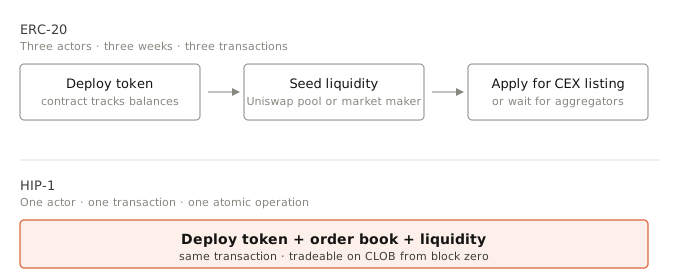
On every other chain, token creation and market creation are separate steps.
You deploy an ERC-20 on Ethereum. That gives you a contract that tracks balances. It does not give you a market. To get a market, you go find a Uniswap pool and seed it with liquidity, or you negotiate with a CEX listing team, or you wait for aggregators to pick you up. Three separate actors. Three separate economic operations. Three separate weeks of waiting.
HIP-1 collapses all of this into one atomic operation. The token and the order book come out of the same transaction. There is no "we deployed, now we're looking for liquidity partners" phase. The order book is part of the deployment.
This isn't a cosmetic improvement. It's a structural one. The listing process — the single biggest gatekeeper in crypto — stops being a process at all.
What Is HIP-1? Understanding the Native Token Standard
HIP-1 is Hyperliquid's permissionless listing primitive — a native fungible token standard that atomically creates a capped-supply token and a central limit order book paired with USDC in a single transaction.
A deployer specifies six core parameters:
- Name — up to 6 characters, human-readable, no uniqueness requirement
- weiDecimals — smallest indivisible unit (like ETH's 18 decimals)
- szDecimals — minimum tradable increment on the order book
- maxSupply — hard cap that can only decrease via burns
- initialWei — optional direct allocations to specific addresses
- anchorTokenWei — proportional distribution to holders of any existing HIP-1 token
Here's how it compares to ERC-20:
| Property | ERC-20 | HIP-1 |
|---|---|---|
| Creates token | Yes | Yes |
| Creates market | No (separate step) | Yes (order book in same tx) |
| Market type | None (need AMM or CEX) | CLOB paired with USDC |
| Supply | Configurable, can be uncapped | Hard-capped, can only decrease |
| Listing process | Find LP, create pool, or apply to CEX | None — automatic |
| Fee economics | Gas only | Deployer earns 100% of fees by default |
| Decimal precision | Developer choice | Protocol-enforced (szDecimals + 5 ≤ weiDecimals) |
The order book is a real CLOB, not an AMM curve. Limit orders, market orders, price-time priority — the same matching engine that runs Hyperliquid's perps. New tokens get institutional-grade market microstructure from block zero.
The Dutch Auction Deployment Gate
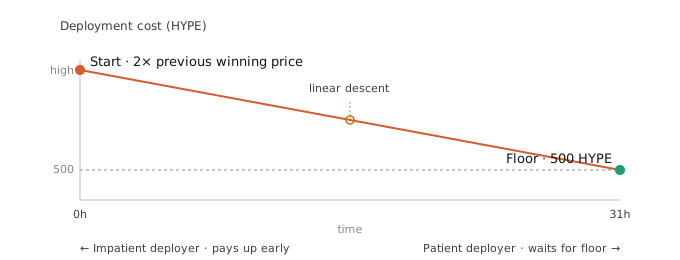
Deployment isn't free. It's gated by a 31-hour Dutch auction that discovers the price of a listing slot.
The mechanics:
- Each auction lasts 31 hours
- Starting price: 2x the previous winning price (or 500 HYPE if the last auction didn't complete)
- Price decreases linearly to a floor of 500 HYPE
- Only one buyer per window — first to pay wins the slot
- After paying, there's no time limit to actually deploy — the slot is reserved indefinitely
- Gas is irreversible: if you lock in bad parameters, there's no refund
One subtle detail: since May 22, 2025, auctions are paid in HYPE, not USDC. This creates a reflexive dynamic where demand for listing = demand for HYPE.
The auction solves two problems simultaneously. It prevents spam — at 500+ HYPE minimum, casual listings are expensive. And it fairly prices urgency — patient deployers wait for the price to drop, impatient ones pay up. The market decides how much a listing slot is worth in real time.
This is a different philosophy from anywhere else in crypto. Ethereum charges gas (a few dollars). Solana charges gas. CEXes charge listing fees behind closed doors. Hyperliquid makes listing rights a transparent, market-priced auction.
PURR: The First HIP-1 Deployment
The PURR token wasn't a product. It was a stress test.
On April 16, 2024 — two years ago to the week — Hyperliquid deployed PURR as the first HIP-1 token on mainnet. Cat-themed meme coin. No sale. No predefined utility. No roadmap.
The point wasn't to launch a token. The point was to prove HIP-1 and HIP-2 worked on mainnet.
The tokenomics reveal the experimental intent:
- 1 billion PURR total supply (hard cap)
- 500 million airdropped proportionally to Hyperliquid points holders
- 400 million deployed as HIP-2 (Hyperliquidity) liquidity — then burned immediately
- ~100 million remaining in the active liquidity pool
As of this writing, the circulating supply is roughly 598 million. It's deflationary because trading fees paid in PURR get burned on an ongoing basis. Two years after launch, PURR has grown into a real ecosystem token — Hyperliquid Strategies launched options on it in March 2026.
A cat coin as infrastructure test is a very Hyperliquid move. It proved three things in one deployment: the token standard works, the automatic order book works, and the HIP-2 liquidity mechanism works. Everything that came later — HIP-3, HIP-4, the broader ecosystem — was built on the confidence that PURR provided.
The Fee Model
HIP-1 deployers earn 100% of trading fees on their token by default.
They can lower their fee share at any time. They cannot raise it. The decrease is irreversible. For non-USDC tokens, any share the deployer doesn't take is burned.
This turns token deployment into an ongoing business. Deploy a popular token → earn fees from every trade in perpetuity (or until you voluntarily reduce your share). The 500+ HYPE auction cost suddenly makes economic sense: you're not paying to list, you're buying a revenue stream.
Two exceptions:
- USDC as quote token: fees go to the Assistance Fund (the protocol's insurance reserve), not the deployer or a burn
- Volume-based tiers: traders who hit higher volume tiers pay lower fees across all instruments (spot and perps share the same schedule)
There's also a daily spot dust conversion at 00:00 UTC that sweeps up sub-lot balances. Small detail, but it keeps user balances clean without manual intervention.
Why HIP-1 Is the Foundation Layer
Every HIP in this series depends on HIP-1.
- HIP-2 (Hyperliquidity) provides automatic two-sided liquidity to HIP-1 order books. No HIP-1 = nothing to provide liquidity for.
- HIP-3 deploys perpetual futures markets. Many reference HIP-1 tokens as underlyings. The spot price discovery from HIP-1 order books feeds the oracle infrastructure that HIP-3 markets rely on.
- HIP-4 settles in USDH. USDC itself became a spot token via HIP-1 ("USDC also becomes a spot token with an atomic transfer between perps and spot wallet USDC"). The settlement rail for outcome contracts inherits HIP-1's infrastructure.
The progression tells a clean story about progressive removal of gatekeepers:
| HIP | Removes the gatekeeper for |
|---|---|
| HIP-1 | Token listing |
| HIP-2 | Market making |
| HIP-3 | Derivatives market creation |
| HIP-4 | Leveraged derivatives (by removing leverage from the primitive) |
HIP-1 is also the bridge layer. Deployers can wrap ERC-20 tokens from other chains via LayerZero, Axelar, Chainlink, Debridge, or Wormhole. System addresses handle automatic HyperCore ↔ HyperEVM balance synchronization. This means HIP-1 isn't just for native tokens — it's the gateway for the entire EVM token ecosystem to enter Hyperliquid's order book.
The HIP-6 Question
There's a tension in HIP-1's design.
The Dutch auction is a quality gate. At 500+ HYPE minimum, you filter out casual spam but also filter out grassroots community launches. On Solana, pump.fun lets anyone deploy a token for pennies and see if it catches. On Hyperliquid, deploying a token costs thousands of dollars before you know if anyone cares.
The community has been discussing HIP-6 as a response — a more pump.fun-like permissionless launch mechanism using Continuous Clearing Auctions. Hypurr Fun Bot already operates as an unofficial bonding-curve launcher in this direction.
The open design question: is listing supposed to have a quality gate (HIP-1's answer) or should the market decide which tokens survive (HIP-6's philosophy)? Both approaches are live. Neither has fully won.
What Clicked
The listing process is the bottleneck of every other chain. HIP-1 removed it.
Token creation and market creation had always been separate economic activities performed by separate actors. You built a token. You negotiated for liquidity. You applied for listings. Three-step workflow, every time, for every project.
Hyperliquid fused these into one transaction. That compression is what makes everything downstream possible. HIP-2's automatic liquidity, HIP-3's builder-deployed perps, HIP-4's outcome contracts — none of them work without HIP-1 collapsing the listing step first.
Hyperliquid HIP-1 removed the listing bottleneck that every other chain still has. What I'll watch for: whether HIP-6 ships and changes the economics of launching on Hyperliquid, and what tokens beyond PURR end up mattering on the spot layer. The infrastructure is in place. What gets built on it is still being decided.